The government doesn’t have a monopoly on tough choices – though it can make those made by people across Scotland a lot easier

Ahead of today’s Scottish Budget announcement, CCPS CEO Rachel Cackett calls for investment in care and support to ease the ‘tough choices’ being made every day across Scotland.

I’ve been watching the pitch rolling on the Scottish Budget over recent days. Tough choices? Absolutely. But I have been disappointed to see social care not even get a mention.  

As the political noise increases today, we must remember that the government doesn’t have a monopoly on tough choices – though it has the power to make the tough choices made every day by people across Scotland a lot easier.  

For ordinary people, tough choices are getting tougher. This is what they look like: a family wondering how to get a parent out of hospital to avoid them getting frailer when no social care is available in the community.  

A person with a disability wondering which bit of basic dignity in life they should give up because their social care services are being cut.  

A family facing homelessness in hard times wondering how to get support and a safe home to look after their children when none is available.  

A person struggling with their mental health wondering how to cope when the threat of loss of support hangs over them every day.  

A support worker (most likely a low-paid woman) having to face the potential loss of income because the service they work in is being scaled back.  

This is the human face of tough choices when too little national prioritisation is given to investment in care and support. This support happens behind closed doors – support which underpins the very fabric of our society. It is done quietly, with dignity (and rightly so).  

But that means we need our politicians, more than ever, to speak up and make a noise so people get the support that any one of us might need tomorrow.  

“2026 can and must be the year where we make a rights-based, sustainable system of social care and support a reality in Scotland.”

I hope the absence of advance social care messaging is not an indicator of the tough choices this government is choosing to announce this afternoon. But if it is, things are about to get a whole lot tougher for the 1 in 23 people who need care and support, their families, and the paid staff in our sector.  

The Scottish Government has an opportunity this afternoon to signal a real step change in its approach to funding our sector. 2026 can and must be the year where we make a rights-based, sustainable system of social care and support a reality in Scotland. But for this vision to be realised, we need the right investment in the budget.   

Member Spotlight: “We have a voice, and we can and must use it to influence change”

In this video, CrossReach CEO Viv Dickenson talks about the organisation’s wide range of services, and the importance of speaking up for those in need of support.

CrossReach delivers care and support across Scotland. Through specialist teams in Children and Families, Adult Care and Older people, they operate over 70 services as the social care arm of the Church of Scotland.

The Moderator of the General Assembly of the Church of Scotland, Rt Rev Rosie Frew recently spent time with CrossReach, visiting a number of services. The short film series ‘Love from CrossReach’ captures these visits. The series explores the motivation behind work of CrossReach, meets staff who work for the organisation, and introduces some people who receive support.

In this latest episode, ‘It’s Complicated’, the challenges within the social care system are explored. Hear from Viv Dickenson, CEO of CrossReach, about the importance of working together with other social care providers, so that we can ensure those in government are well informed about the challenges being faced in Scotland today.

Member Spotlight: Phoenix Futures on the ‘Restorative Power of the Outdoors’

In our latest Member Spotlight, Rachel Hudson, Living Skills Worker at Phoenix Future’s Recovery Housing Service in Glasgow, explores the role of nature in recovery from drugs and alcohol.

Image of author Rachel Hudson. Rachel has long dark hair and is wearing all black. She is standing looking at the camera and smiling.

Rachel Hudson, Living Skills Worker at Phoenix Future’s Recovery Housing Service in Glasgow

At Phoenix Futures Scotland, we believe recovery from drugs and alcohol is not only possible, but also transformative. Our mission is to help people reach their full potential, for themselves, their families, and their communities. At the centre of this vision lies our Recovery through Nature (RtN) project, a programme that harnesses the restorative power of the outdoors to support people on their recovery journey.

A pathway to healing

Recovery through Nature is more than a therapeutic programme, it is a pathway to renewal. Participants take part in practical conservation and horticultural projects, finding new purpose in activities that connect them to the natural world. At Phoenix Futures Scotland, RtN is a core part of the programmes we deliver in our residential, housing and community services.

Research shows that time outdoors improves mental health, physical health and recovery outcomes. Getting active on a regular basis helps boost fitness, strength, and energy levels. People who got involved in RtN in our services saw an additional 17% improvement in their physical health compared to those who did not take part.

Being outdoors and moving around can also help the body heal from damage caused by substance use. Plus, sunlight supports better sleep and increases Vitamin D, which can lift your mood, and that can really help with recovery. For alcohol use, there was a 23% improvement in outcomes for those who took part in RtN compared to those who did not. We also see that people who take part in Recovery through Nature are nearly twice as likely to finish their recovery programme.

“Recovery through Nature is more than a therapeutic programme, it is a pathway to renewal.”

In nature, people discover space to slow down, reflect, and restore balance. This is especially vital during early recovery when stress levels are high. The secret to RtN’s success is simple: creating safe, enjoyable environments where learning and growth can flourish.

Trees being planted at Phoenix Forest at Glenlude

Phoenix Forest at Glenlude

Rediscovering joy

I am a Living Skills Worker in our Recovery Housing service in Glasgow. From canal banks to hilltops, we have embraced RtN as a way to reconnect with the world around us. We run Recovery through Nature as part of the programme we deliver and each activity offers a fresh perspective, reminding our residents that recovery is not just about overcoming challenges, it is about rediscovering joy.

Earlier this year, we partnered with North-West Recovery Community to deliver a 12-week programme at Hamiltonhill Claypits Local Nature Reserve. Together with local organisations, we offered sessions ranging from forest meditation and fire ceremonies to water sports. The diversity of experiences helped participants see nature not just as scenery, but as an active partner in their recovery.

One participant reflected: “I love the outdoors, but due to my addiction I had been unable to see it. Recovery through Nature has helped me get back out, and I’m able to see and appreciate it again.”

A group of people in a forest digging and looking at the earth

Phoenix Future’s Recovery through Nature project

Sharing stories and growing together

Our collaboration with the University of Stirling brought Recovery through Nature to a wider audience through the Green Threads documentary. This project highlighted the profound impact of nature on wellbeing, giving our participants a platform to share their voices and experiences.

At the Concrete Gardens allotment in Glasgow, our residents have embraced our ‘seed to table’ ethos and have learnt to grow, harvest, and cook their own food. This not only provides fresh, healthy meals for our residential service but also teaches valuable life skills. Growing food together shows that recovery, like gardening, requires patience, nurture, and time.

Our work at the Calman Centre at Gartnavel Hospital, alongside the Beatson treatment facility, has been especially meaningful. Our residents have helped develop gardens that support people in recovery, with one sharing: “It feels so good to get out into the community and be able to give something back.”

Celebrating recovery through nature

This year, we are proud to have been shortlisted in the 2025 Nature of Scotland Awards in the Health and Wellbeing category, alongside our wonderful partners at the John Muir Trust. For the past 13 years, participants in our RtN project have been planting trees and growing the Phoenix Forest at Glenlude to celebrate everyone who has successfully passed through one of our programmes.

“The diversity of experiences helped participants see nature not just as scenery, but as an active partner in their recovery.”

Building partnerships, building futures

Partnerships are at the heart of Recovery through Nature. By collaborating with local organisations, we enrich recovery journeys and create lasting connections within communities. These partnerships ensure that participants not only benefit during their time with Phoenix Futures but continue to engage with supportive networks long after.

Whether it is planting a seed, climbing a hill, or simply spending time outdoors, every RtN experience helps people rediscover belonging. As we continue to build partnerships across Scotland, we remain committed to creating spaces where recovery can take root and flourish.

Urgent action on pay key to reforming social care

With a report published today on the impact of the Adult Social Care (ASC) Worker Uplift Policy, Rachel Cackett explains why it’s time for the Scottish Government to change course

We are standing at a pivotal moment for social care in Scotland. In recent years, policy decisions from austerity to Brexit, combined with external shocks including Covid-19, have placed immense pressure on our sector, and we now find ourselves at a tipping point. With the Scottish Government’s spending review and Budget approaching, the time for action is now.

There are clear paths to navigate our way out of this crisis, but for these to be realised, we need the government to show us it recognises the immense and wide-ranging benefits our sector brings to our society and our economy. A key part of this will be investing in the qualified, highly skilled and professionally regulated workforce who provide life-changing support in our communities every day – and whose pay is in the hands of the Scottish Government.

We need fair pay because our staff – who provide highly skilled support to disabled people, older people, people with learning disabilities, children, families and many others – deserve their invaluable contributions to be recognised. We also need fair pay because it makes social care a sustainable career choice, supporting the viability of our sector, and helping us better weather any future storms.

We know that the government has made public commitments to Fair Work. Its Adult Social Care (ASC) Worker Uplift Policy initially promised a real commitment to fair pay for social care professionals. But despite its good intentions, the policy has not kept pace with a shifting economic landscape and has also faced several unforeseen challenges in its implementation. We think the policy is no longer fit for purpose, and staff and the wider sector are feeling the strain.

That’s why my organisation, the Coalition of Care and Support Providers Scotland (CCPS), is calling on the Scottish Government to urgently review this policy and revise its approach to social care pay immediately, before swiftly introducing sector-wide bargaining on pay. After conducting research on our members’ experience of this policy in action, we have today published a report on our findings, The Impact of the Scottish Government’s Adult Social Care Worker Uplift Policy. Click here to read the report.

Our message is clear: despite its best intentions, this policy is not working on the ground, and social care staff and the wider sector deserve better. We need the government to listen to our members and take urgent action to fulfil its promise of fair work and pay without delay.

Social care and support staff provide the scaffolding needed to help people live independent and fulfilled lives. They also provide preventative support which reduces costs for other public services, including the NHS – so by investing more in social care now, the Scottish Government cuts costs now and in the long run.

Despite this, pay policy is far from where it needs to be. The government’s policy has, since 2016, been to ensure that all ASC workers delivering direct care in commissioned services are paid at least the Real Living Wage. But this figure (currently £12.60/hour) is nowhere near enough to mitigate the staffing challenges our sector faces. ALDI pays its staff a minimum of £13/hour. On top of this, without funding to maintain proper pay differentials between staff of different grades – which our research shows is often not possible – social care will not be an attractive long-term career choice.

We welcome the government’s commitment to sectoral bargaining as its approach to social care pay and have been working collaboratively with them, alongside employers and trade unions. But this is simply taking too long; we need action now.

Investing in our people and making our sector better able to attract and retain staff will be hugely impactful when it comes to building strong, secure foundations for the rights-based, sustainable system of social care and support our country needs. And there is no time to lose. We know the Scottish Government has the appetite for reforming social care, and we as a sector are ready and willing to support them in realising their vision for fair work and pay.

We need tangible action now – for our staff, mostly women, doing invaluable work; for the one in 25 people who need social care each year in Scotland, as well as their friends, families and communities; and for the other public services such as the NHS whose work we support. The upcoming spending review and Budget offer a prime opportunity for action.

The government must urgently work with us to review its approach to social care pay – as part of the response to the viability of our sector. This will ensure our staff are paid fairly for the vital work they do and that providers can fully fund their workforce costs.  The future of our sector, and the government’s ambitions for reform, depends on it.

“It’s the start of a culture shift in how Scotland supports mental health”

Member Spotlight: Ewan Hay, Service Manager at The Nook from SAMH in Glasgow, shares how the project aims to break down barriers to accessing mental health support.

The Nook is the most ambitious project in SAMH’s 102-year history. Beyond that, it is the largest mental health charity initiative in Scottish history. It’s a groundbreaking £10 million plan that aims to revolutionise access to support for tens of thousands of people.

The Nook in Glasgow, where I am manager, is the first in a national network of walk-in mental health support hubs, enabling anyone in Scotland to ask once and get help fast.

We know that Scotland is in a mental health crisis, with demand increasing, waitlists growing and services stretched to breaking point. The Nook is our response. It provides barrier-free access to mental health support, with no need to book an appointment or get a referral, in a safe, welcoming, stigma-free space.

It will also help to relieve pressure on the NHS by supporting people that may be on a long waitlist, delivering preventative care and early interventions. Before this role, I worked as a paramedic and project coordinator. I saw firsthand how delays and long waitlists for mental health support can have a significant impact on people’s wellbeing. When I heard about The Nook and SAMH’s commitment to offering support with no need for a referral or waitlist, I knew it was something I wanted to be part of.

What makes this role unique for me is the combination of professional and personal purpose. As a paramedic, I was often the first person to meet someone in crisis, but I rarely got to see what happened after that first call. Here, I get to be part of the ongoing support, seeing people move from that first ask for help to recovery, sometimes just through a single meaningful conversation.

Help at The Nook ranges from one-to-one support and group sessions to talking therapies. We will also roll out an extensive outreach programme, helping many thousands more based in surrounding areas.

But the real innovation isn’t just in what we offer, it’s how we offer it. The Nook is about human connection first and foremost. We meet people as they are, not as a referral or diagnosis. I believe that’s crucial: when you remove barriers, when you make it easy to ask for help, people actually do. That’s where real prevention begins.

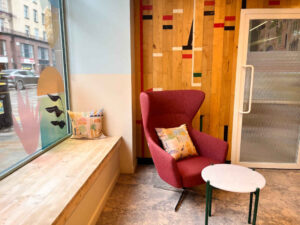
A photograph of the interior of the Nook in Glasgow, showing a cosy seating area with a window seat and a red armchair next to a small table.Our expertise is non-clinical mental health support, so the space has been deliberately designed to be welcoming, accessible and inviting. I’m fortunate that in addition to my team of practitioners, I also have the support of trained volunteers to welcome anyone who walks through our doors.

As a team, we’ve spent a lot of time thinking about how to make The Nook feel different, less like a service, and more like a community. Everyone who comes through the door is treated as an equal. There’s no stigma, no judgement, and no time limits on being heard. My hope is that this approach helps people reconnect with the idea that support can be simple, human and immediate.

The Nook in Glasgow opened its doors this month, with Aberdeen to follow next year and plans for Edinburgh, Inverclyde and Lanarkshire already in the works.

For me, this is more than just the start of a project, it’s the start of a culture shift in how Scotland supports mental health. If The Nook proves anything, I hope it’s that we can build systems that put compassion and accessibility at the heart of everything.

Member Spotlight: “We have the expertise, imagination and passion and we are going to put it to work”

Mark Bevan, Chief Executive of national respite charity Leuchie House, on rethinking its response to future need – and its aim to grow impact tenfold by the end of the decade

The typical age of diagnosis of a long-term neurological condition, for those Leuchie serves, is in the late 40s / early 50s. It’s a time when most of us are mortgaged to the hilt, working as hard as we ever have done and if we have children, they need all of our support through their difficult teenage years.

It’s against this backdrop that a diagnosis occurs, often after a long process. Very soon, many will no longer be able to walk, work will become impossible and with the loss of employment comes the loss of income, friends and the opportunity to support a family.

A healthy, independent and fulfilled future can seem impossible to imagine and trying to get support from our overwhelmed health and social care service is a daily battle. A visiting GP said last week that it takes on average two years for a specialist neurological appointment.

Help with care at home is getting even harder to find. This means that ever more physical and emotional responsibility for health and care delivery falls to immediate family, who themselves can become overwhelmed, exhausted and isolated.

This is not only a challenge today for a few vital individuals. With an ageing population and reducing workforce in Scotland there will come a point, within all of our lifetimes, when there is an insufficient care workforce to meet the needs of the significant many. Some would say we have reached the tipping point already.

This is being experienced today by many who need health and social care now. It’s a concern we are beginning to address at Leuchie, with those who come to have a break with us who have a condition such as multiple sclerosis, Parkinson’s disease, Motor Neurone Disease and some aspects of stroke.

For nearly 15 years the Leuchie House team has been developing award-winning and Grade 5/6 quality health care and support services in the face of growing demand, a challenging labour market and ever tighter fiscal constraints.

With people coming to Leuchie House from all over Scotland and further afield and with bookings running a year or more ahead, we face a challenge: how do we do more of what we do well?

Our first response was to fundamentally re-imagine respite. We had fallen into a trap of conflating our purpose, with how we go about delivering that purpose. The walls of our building had become a constraint on our thinking.

So, we took on a purpose-built holiday home with the highest levels of equipment and access standards. This enables families to have a break together. On the strength of this we worked with a manufacturer to produce a highly accessible caravan, which we now also run. These two facilities doubled the number of families we could support and broadened that support, beyond the walls of Leuchie House.

We began to look at the causes of stress in the lives of the people we support as a route into thinking and creating solutions around what people wanted respite from.

We identified health improvement, re-enablement through technology and re-connecting people to social and professional relationships as three priorities. Consequently, we invested in a highly sophisticated in-house team of allied health professionals including an in-house health care technology team. We now ensure that the impact of a break can last long beyond the break itself.

As we approach our 15th birthday in 2026, we will step up this way of thinking about future need and we will respond. Our intention is to grow our impact tenfold by the end of the decade, and to do so in four ways:

We will:

  • Provide physical, building based & specialist services where they don’t exist today.
  • Be present through technology in the homes of people who we don’t reach in physical resources.
  • Deploy and manage enabling technology to maximise independence within people’s homes.
  • Reach into the rich experience and expertise, developed over 15 years and in partnership with those we serve, their families, our NHS, universities, institutional grant makers and private sector investment to develop and deliver solutions through innovation and research.

Waiting for governments to answer the problems which we are driven to resolve is not an effective solution. We have the expertise, imagination and passion and we are going to put it to work…just like you do every day.


“Care and support must be guaranteed for all those with dementia”

Member Spotlight: Jim Pearson, Deputy Chief Executive of Alzheimer Scotland, on the charity’s Stop the Cuts campaign and its work to build a national, consistent standard of care

At Alzheimer Scotland, it is our mission to make sure that nobody faces dementia alone.

Dementia is caused by disease processes such as Alzheimer’s disease and is a progressive and life limiting condition which, over time, affects every aspect of daily life.

A diagnosis of dementia is life-changing not only for the individual but for their family. It is Alzheimer Scotland’s view that every person diagnosed with dementia has the right to receive the proper care, treatment and support which responds to the changing, often complex, symptoms and needs as the illness progresses.

However, too often we hear from people living with dementia and those who care for them that they are left alone to deal with the changing and increased levels of need dementia brings, with often limited or no help.

While illnesses such as cancer, chest, heart and stroke all have clear pathways mapping out exactly how a person will be treated and cared for at every stage – dementia has no such pathway in place. There is often no offer of regular care reviews or annual check-ups with health professionals.

Right now, in some of the most extreme funding cuts ever seen, vital health and social care services supporting tens of thousands of people living with dementia, their families and carers are being forced to reduce the support they can offer, or in many cases close completely.

In a desperate bid to plug predicted budget gaps, Integration Joint Boards (IJBs) across Scotland are having to find millions of pounds of savings. Much of those savings are being planned by cutting funding from their older people and community care budgets, where the mainstay of community support and dementia-specific services can be found.

These cuts are both unacceptable and short sighted. They will inevitably lead to more people experiencing avoidable crises, increased levels of need, and growing demand on an already overstretched health care system through avoidable and more expensive hospital admissions.

Scotland is sleepwalking into a dementia care crisis.

It is these issues that inspired Alzheimer Scotland to launch a new national campaign to ‘Stop the Cuts’ to community dementia care funding. In a matter of weeks more than 12,000 people have signed our petition in support of the campaign.

We have also been inundated with messages of support and high levels of engagement on our social media posts, helped by support from our CCPS partners.

The campaign calls for the introduction of a guaranteed national pathway where evidence-based interventions are offered to everyone with a dementia diagnosis throughout the progression of their condition – every time, everywhere throughout Scotland.

It is estimated that around 90,000 people in Scotland are living with dementia, and this number is expected to rise significantly in the coming years. As the population ages, the demand for dementia services will inevitably increase, making it essential that we have robust systems in place to support those in need.

It is not right that dementia care is left to a postcode lottery.

We have written to all MSPs, MPs and council leaders across the country, as well as to ministers and local government body COSLA calling for urgent action.

As we look ahead to the Scottish Parliament elections in May 2026, we will continue our campaign to stop the cuts, protect dementia services, and build a national, consistent standard of care that ends the postcode lottery for good.

To find out more about Stop the Cuts and to sign our petition visit https://www.alzscot.org/StopTheCuts/

“The resilience of our sector is under extreme pressure. There is time to turn things around – but only with immediate action taken in partnership”

CCPS CEO Rachel Cackett on today’s open letter to the First Minister and the Herald’s hard-hitting report into the threat posed to social care

I was up very early this morning to read the Sunday Herald.

Over the past few weeks, writer-at-large Neil Mackay had interviewed a number of Chief Executives of health and social care organisations who are members of CCPS and the ALLIANCE – as well as myself and ALLIANCE Chief Officer, Sara Redmond. He wanted to understand the absolute tipping point faced by charities trying to deliver public services on contracts that just haven’t kept up with costs or demands. In addition, nearly 250 organisations have signed a joint letter to the FM from the ALLIANCE and ourselves calling on the government to increase investment at pace, and work with us, to stabilise our sector.

It’s a big and very hard-hitting piece – reflecting the gravity of the position – and the body of Neil’s article really conveys the dilemma facing so many not-for-profits providing social care and support: do they keep providing vital services through public sector contracts that are too often too poorly funded to preserve quality and dignity; or do they hand these contracts back and see people’s critical support reduced and jobs lost? Both come with real consequences for real people. It’s a story that has been too long under the radar and needed told.

At CCPS a survey of 50 major social care providers earlier this year set out that around two-thirds were planning to eat into their charitable reserves this year to deliver public services and of, these, around 90% would not be a going concern in 4 years if that situation continued.  That’s a wake up call for us all.

There is still – just – time to turn this around, but it’s running out. Hammered by long-term underinvestment, wages set too low by the Scottish Government and now huge increases to national insurance bills from Westminster, there is no longer the time to just look on and ask us to wait.

I speak to our outstanding CEO community regularly. They, and their organisations, are resilient and creative – they’ve had to be for so very long to make things work. But that isn’t sustainable for ever and they can’t be taken for granted.

With a spending review and budget coming up it is absolutely THE time to make some key decisions for the future of crucial support for individuals, families and communities across Scotland. That is the basis of our joint call to the First Minister.  Organisations like those I represent can provide so many of the answers to the policy aspirations for the people of Scotland which this government – and indeed all the political parties – have set out.  But we can only do that if we are here as a sector that is surviving and thriving.

We want to work with politicians and officials to build a better social contract with the people of Scotland, where people’s rights and dignity are honoured and valued, even when times are tough. Our door is open.  It’s time to act.

Read the open letter to the FM and our news story


“In whatever we do, the person always comes first”

Member Spotlight: 200 years after Right There began its vital work to prevent homelessness, CEO Janet Haugh celebrates the charity’s successes, while reflecting on the inequalities that persist for too many in society today

Over the last year Right There has celebrated its 200th year, a year that allowed us to celebrate and reflect on our roots, and the journey our charity has been on, supporting people experiencing and challenged with homelessness.

As we move on from this significant milestone and focus on the next part of our journey it strikes me that the issues that drove our founder David Naismith to start our charity back in 1824 to provide a lifeline for young men in Glasgow who were suffering from growing inequalities, are no different from the issues faced by so many in society today. And that is a reality that saddens me but also causes me intense frustration.

At Right There, as a charity we are driven by the desire to help individuals through preventing and tackling homelessness, one person at a time. Over two centuries the charity has expanded its demographic to support anyone of any age facing a tough time, with the vision that everyone deserves an equal chance to have a safe and supportive place to call home. Our support is tailored to the needs of each person, and we pledge to be right there for as long as it takes. We rarely think of this support in monetary terms; we measure our impact by the journey each individual takes, and the difference we make to their lives.

However, to mark our 200th anniversary we commissioned a study to evaluate just how much our support saves the public purse. We thought that was important given the current economic climate we are working and living in, and at a time when public finances are under more strain than ever. Our study illustrates the difference that our unique approach makes to taxpayers as a financial saving. Essentially, this defined our support in financial terms, with the hope that it would reinforce the vital role charities play in Scottish society. The research showed us that for the 4,000 people we support each year, the saving to taxpayers, using a social return on investment approach, is in excess of £300m. Given the current climate, the significance of this cannot be underestimated.

Our overarching focus at Right There is to prevent people becoming homeless and separated from their loved ones. But homelessness is part of a vicious cycle which can include people living with the effects of poverty, addiction, or broken relationships – essentially those who are most at risk of social inequality.

CEO Janet Haugh pictured at the launch of Right There’s social impact report last year

The evaluation was carried out in the context of economic, political, social, and environmental factors that have and are continuing to shape the third and public sectors, to show the social benefit to society achieved through our work. It looked at savings to the public purse through the likes of long-term health and social care, unemployment benefits, emergency accommodation and by helping to stop people’s problems from worsening.

Savings that were measured include the cost of NHS treatment for issues such as substance use and poor mental health; the avoidance of future interactions with the criminal justice system; the benefits of individuals moving into longer term, more sustainable accommodation and savings to the Scottish economy in supporting individuals towards employment.

Knowing that the work we do is saving taxpayers a significant amount of money is great, but knowing that our work helps people feel happier, safer, and more confident to take steps to improve their own lives is even better. And we know our approach works. By understanding that every person’s story is unique, and everyone’s route home is different, we tailor our response to the individual. In whatever we do, the person always comes first, and we are supporting more than 800 people each day with this approach.

While we can celebrate our achievements, we can’t get away from the fact that Scotland’s housing crisis is intensifying. We’re not at risk of crisis; we are living it. As a charity that has existed for over 200 years to help prevent homelessness, we are in no doubt that our work is far from over. Yes, our work is saving the public purse but that does not negate the need for investment, and the need to invest in this sector right now is more critical than ever.

Janet Haugh is CEO of Right There

“For the sake of the Scottish people, and our economy, announce a programme for social care” 

Tomorrow the First Minster has an opportunity to do what’s both brave and economically wise, writes Rachel Cackett

Tomorrow – as a late surprise – John Swinney will deliver his last Programme for Government of this parliament. Given none of us was prepared for the sudden appearance of this (and equally none of us is quite clear what has happened to the full scope of the one-year programme announced just last September…), perhaps, in keeping with the surprises, we can hope that some rabbits might get pulled out the hat.

Social care certainly needs one.

The FM has said that “delivery and hope” and “a very radical programme” will be at the heart of his agenda. Well, we could do with some of those too.  

But in the press trailing of the announcement, I’ve not seen social care mentioned once.  Perhaps this is because we really are going to be the grand end-of-speech unveiling.  I hope so, because we have been absolutely clear with the Scottish Government about the state our sector is in, and the consequent risks facing people who are in receipt of support, those who care for them and the wider paid workforce in the sector.   

The human and economic costs of getting things wrong in social care over the next 12 months will be profoundly negative.  There is only one reasonable option here – invest.  Why?  

Because you cannot have a vibrant, equitable economy – and end child poverty too – if: 

  • The NHS, justice and education departments have to step in to waste many millions of taxpayers’ money on wholly avoidable crisis interventions  
  • People cannot be supported to enter or remain in the job market or stay engaged in education or training 
  • Family members cannot continue in work because they are the only option to provide essential support 
  • A major skilled Scottish workforce, made up of over 80% women, are paid too little by government setting baseline wage rates too low 
  • These same skilled staff lose their jobs because services close, and 
  • The loss of services and organisations in our sector has a direct knock-on impact on Scottish suppliers – many of them local businesses. 

We don’t talk enough about the underpinning of our economy, and aspirations, around the eradication of poverty and inequality by social care and support. But tomorrow we need John Swinney to recognise this direct link. There is real urgency here.   

The charities and not-for-profits in CCPS membership, who deliver much of Scotland’s social care, have faced years of underinvestment, rising costs and now huge increases in employer national insurance. Together these are resulting in a systemic destabilisation of the market. In February, we surveyed our members and found that in this financial year: 

  • 57% are seriously considering handing contracts back to commissioners.  
  • 55% are seriously considering reducing the amount of support available. 
  • 92% say lack of eNICs reimbursement will negatively impact their pay award. 
  • 67% are budgeting on the basis of reaching financial balance through reserves and, of these, 91% will no longer be a going concern within 4 years if they continue to reach financial balance in this way.  

(Our survey covered 50 major not-for-profit providers in membership, with £850m income, 28,000 staff and supporting 230,000 people in total).

We now need the Scottish Government to come up with a radical plan of investment to avert a truly terrible position for everyone in Scotland who needs, and delivers, social care and support.  

I know that choosing to allocate investment here may leave some risk elsewhere in the overall Scottish budget; but I am also clear that failing to invest here leaves utterly unacceptable levels of risks in the hands of supported people, their loved ones and staff on the frontline.  Inaction is a political choice. 

So, First Minster, do the brave and economically wise thing:  protect some of our poorest and most vulnerable citizens and pull this rabbit out of the hat in tomorrow’s speech.