The Scottish budget for third sector social care: is it all costs, no value? 

There is no money: The mantra of the moment.  
Rachel Cackett

There is no money: The mantra of the moment.

But clearly that’s not really the case.

Scotland’s resource funding for 2023-24 is almost £42bn[1]. Now, inflationary pressures alone will clearly mean that won’t go as far as £42bn a year ago. And the economic outlook is certainly gloomy. Money is tight for sure; very tight. But when costs are high and budgets under pressure, political allocation decisions show relative value in a stark light.

In this context, the relative value this Scottish Budget places on third sector social care organisations, their staff – and on the people requiring social care and support – is really poor.

In his Budget statement, we heard the Deputy First Minister herald a “formidable pay settlement” for the NHS this year and a 40p per hour uplift for our social care staff next year.

It is therefore no surprise that there is tremendous anger in our sector at this small, comparative uplift in the midst of a recruitment and retention crisis that threatens the critical services we provide to people across Scotland.

Since the Budget was announced though, I have been reflecting on a conundrum.

The Scottish Government clearly takes the responsibilities of staff providing social care and support seriously. These are people who work closely with older people, children and families, disabled people, people with learning disabilities, who are homeless, who are experiencing ill health, including poor mental health, who’ve been through the criminal justice system. And just look at how the government has acted to change the sector over recent years:

Social care and support staff are skilled practitioners who are now required to meet professional qualification requirements.

Social care workers are now professionally regulated. They must abide by Codes of Practice and can be suspended from, or removed from, the register if concerns about their fitness to practise are upheld.

They work in highly regulated services because, of course, it’s important that people using those services receive high quality care from employed staff.

And they are subject to PVG checks because support workers must demonstrate they are suitable to work with people who are vulnerable.

All, in principle, understandable changes in the context of the significant responsibilities held by social care and support staff.

So, here’s the conundrum: The government thinks that frontline social care staff need to be skilled, qualified, professionally regulated and police checked because of the responsible, high-risk nature of the work they do, and yet… they are worth only £10.90 an hour from April. They are worth only what the Living Wage Foundation has set as the minimum amount to ‘get by’.

For me, that’s a balance sheet that just doesn’t add up.

The Scottish Government keeps repeating that social care staff have received a 14.7% pay rise over the last two years.

But that’s a game of walnuts under cups. Let’s clarify a few things.

First of all, percentages very conveniently hide huge disparities in the cash people receive. In April 2020, the basic gross salary funded by the Scottish Government for an adult third sector support worker was £18,135. In the NHS someone doing the equivalent job[2] was on £20,700 (and let’s not even start on the differences in pensions and other benefits).

This year, a third sector support worker salary funded by Scottish Government was £20,475, unlike their NHS equivalent who was awarded £23,914.

Despite a government commitment to Fair Work in Social Care dating back to 2019, the salary gap between equivalent posts has actually increased from 14.1 to 16.8% in the past two years.  In terms of parity, our sector has gone backwards. In fact, a third sector adult social care worker on a basic salary as funded by Scottish Government in 2022 now earns less, in cash terms, than the equivalent NHS worker earned in 2020.

Second, let’s be clear that the Scottish Government has chosen to apply social care uplifts only to those providing registered services to adults. Everyone else, staff in children’s services for example, have had no guaranteed uplift funded from Scottish Government.

And here’s another thing….The much-quoted 14.7% uplift oddly includes a pay rise no-one has even seen in their pay packet yet. In a most unconventional move, the government has chosen to include the recently announced April 2023 pay uplift (again only for adults) in their headline figure for the ‘past two years’[3].

And all these figures for social care staff apply only to those employed by not for profit and independent sector organisations, such as charities who are commissioned to provide public services. They don’t apply to social care staff employed by councils – who do equivalent work. Following the intervention of Scottish Government, local government staff also enjoyed a far higher pay rise this year – from a higher baseline – than their not-for-profit colleagues.

This week we compared the social care support worker starting salaries in a number of jobs advertised by local authorities across Scotland. Almost all were receiving at least £1 more per hour than the £10.50 floor set by Scottish Government for our sector. That’s a very attractive £2,000 difference in annual salary.
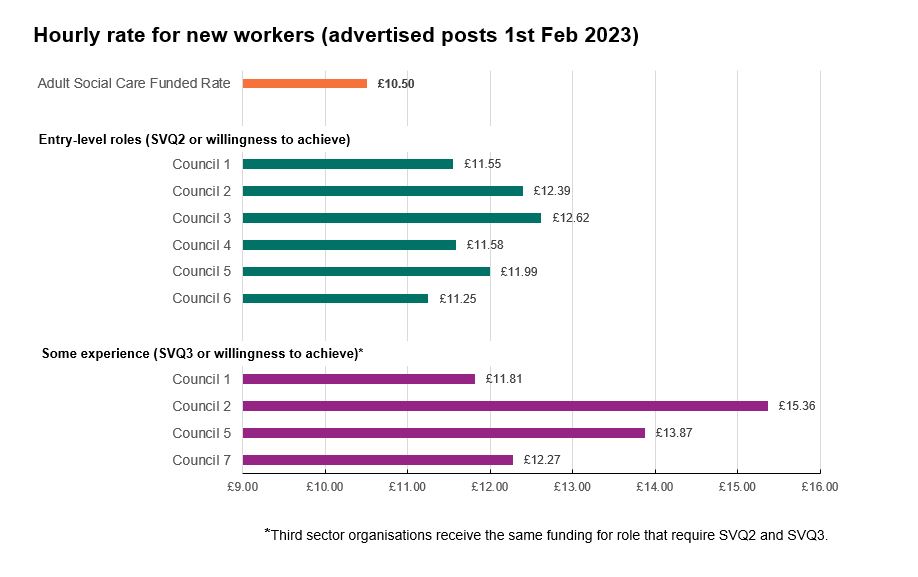
Bar chart showing the hourly rate of new workers in a range of jobs being advertised in the sector as of 1st Feb 2023. Compares the rate funded for the third sector to pay a worker to the rates offered by a range of councils.

Finally, we keep hearing figures from Scottish Government about how much it would cost them to increase salaries for staff in third and independent sector social care organisations. As if those increased wages wouldn’t result in increased tax revenue and spend to offset a good proportion of the additional investment – as the Scottish Women’s Budget Group modelled in their report this week[4].

And as if those increased wages wouldn’t help to ensure services were actually fully staffed to provide the care and support that people right across Scotland need to live independently, stay in work or in school, to be connected and participate in their communities, to be well, to have their human rights respected…  and of course, to stay out of hospital.

Scotland talks a good Fair Work game, but in this budget the Scottish Government makes some pretty stark choices for third sector social care organisations, their staff and the people who rely on social care. These are decisions on costs which do not reflect the value of our staff and the people they work with, and which certainly don’t deliver Fair Work.

The Coalition of Care & Support Providers in Scotland (CCPS), alongside our members, is committed to collaborating with the Scottish Government to deliver on Fair Work for the social care sector. But the threat to our services is real; it is happening now, and we can’t wait any longer.

Even before this winter kicked in, 63% of CCPS members were considering taking emergency measures such as reducing services or handing back contracts. So, we are calling on the government to demonstrate that they really do value third sector social care and support staff. They deserve nothing less – as do the 1 in 20 Scottish people who are likely to need social care support next year.

The costs of not doing so are, quite simply, profound.

So, CCPS is calling on the Scottish Government to take 4 steps to Fair Work now:

  1. Immediately implement the updated Real Living Wage (£10.90), backdated to 22 September 2022, as a minimum uplift for ALL social care support staff in the third and independent sectors.
  2. From April 2023, implement a Scottish Social Care Living Wage by committing to a 2023-24 social care uplift for all staff, to an hourly rate of at least £12.
  3. Pay all uplifts on 100% contract value to ensure employers can invest in all their staff fairly.
  4. And publish a three-year timetable in the next Programme for Government to deliver Fair Work in Social Care through parity of pay and key terms & conditions.

We’re not asking for much; we just want a fair settlement for the people providing vital care across Scotland. So, come on Scottish Government let’s get behind the social care sector…now.

Rachel Cackett
CEO
Coalition of Care and Support Providers Scotland
2 February 2023

[1] Budget 2023-24 | Scottish Parliament

[2] Following publication of the Community Integrated Care report, Unfair to Care, we have used AfC Band 3 pay scales as our comparator. Social care salaries have been calculated using a 37.5 hour week.

[3] Meeting of the Parliament: 19/01/2023 | Scottish Parliament Website

[4] Towards-a-transformative-universal-adult-social-care-support-service-for-Scotland.pdf (swbg.org.uk)
A response to the Independent Review of Inspection, Scrutiny and Regulation (IRISR)

In October 2022, Scottish Government announced the IRISR, to chaired by Dame Sue Bruce and reporting in June 2023. 

In October 2022, Scottish Government announced the Independent Review of Inspection Scrutiny and Regulation (IRISR), to be chaired by Dame Sue Bruce and reporting in June 2023.

The IRISR is looking at how social care services are regulated and inspected across social care support services in Scotland, to ensure a human rights and person-centred approach. It will also consider how regulation and inspection of social care can deliver improved outcomes for people within a regulatory framework that meets the needs of the planned National Care Service (NCS).

Our response was submitted to the Scottish Government via CitizenSpace in December and can be accessed in full here: CCPS IRISR response December 2022

In it, we discuss the importance of investing the time and resource to meaningfully involve supported people in inspection processes. We highlight challenges in the current service registration categories and emphasise the importance of strategic inspection that takes account of the impact of commissioning and procurement approaches on the services our members can provide. We advocate for inspection and scrutiny that is focused on personal outcomes and service improvement, rather than process and compliance. In the challenges of the current context, we note that scrutiny and workforce regulation also need be consistent, realistic and supportive of our member organisations.

A response to the draft Scottish Budget 2023-24 from the CCPS Board and CEO

The CCPS Board and CEO have written a letter to the Deputy First Minister and Cabinet Secretary for Health and Social Care requesting an urgent meeting before the Budget Bill is passed.

URGENT NEWS: CCPS leadership responds to Draft Budget 2023-24

CCPS members met to discuss the draft Scottish Budget on 19 December and expressed both disappointment and anger at the Scottish Government’s lack of recognition or appreciation of the crisis facing third sector social care and support providers. The CCPS Board and CEO have written a letter to the Deputy First Minister and Cabinet Secretary for Health and Social Care requesting an urgent meeting before the Budget Bill is passed. We have highlighted the ongoing lack of parity and respect for our sector and questioned the national commitment to Fair Work. We note to the Scottish Government ministers that, “There simply will not be a sustainable third sector available to deliver your aspirations if you do not act quickly to deal with the issues we face right now”.

CCPS appoints new Director of Policy Programmes

The Coalition of Care and Support Providers in Scotland (CCPS) has appointed Dr Simon Webster as the organisation’s new Director of Policy Programmes.

The Coalition of Care and Support Providers in Scotland (CCPS) has appointed Dr Simon Webster as the organisation’s new Director of Policy Programmes.

Dr Simon Webster joins CCPS having worked as a Research Consultant on Lord Scott’s Scottish Mental Health Law Review within the Scottish Government’s Mental Health Directorate.

In his new role he will continue the CCPS mission to identify, represent, promote and safeguard the interests of third sector and not-for-profit social care and support providers in Scotland.

With the immediate pressure of winter facing the sector, Dr Webster will lead a team to deliver impactful policy across key areas including sustainability and supporting the CCPS response to the Scottish Government’s National Care Service Bill. He will be working across Scottish Government funded workstreams to improve social care.

Prior to joining CCPS, Dr Webster worked with the Mental Welfare Commission’s investigations team where he was Human Rights Policy Manager. He delivered the Independent Review of Learning Disability and Autism in the Mental Health Act, as Secretary to the Review and as an executive member.

He has extensive experience of working to improve conditions for children and young people through his role as CEO of Your Voice, an innovative independent advocacy service, which he led for over a decade.

At CCPS he will be working with members of the Coalition who collectively support more than a quarter of a million people every year.

Welcoming Dr Webster’s appointment, Rachel Cackett, Chief Executive at CCPS said: “This is a hugely significant appointment for CCPS and I’m thrilled to welcome Simon to join our management team.

“Simon is a highly successful and creative policy professional with expertise in social care and support, and the delivery of human rights. I’m looking forward to working with him and all the team at this defining moment for social care as, on behalf of our 91 member organisations, we work to influence Scotland’s reform agenda and drive the change that is required to respond to the urgent winter pressures the sector is facing and to deliver on the Fair Work agenda.”

Dr Simon Webster said: “This is an exciting and challenging time to be joining the team at CCPS. I am delighted to be part of an organisation that is so clearly focused on its membership and how they deliver social care services to a wide range of people across Scotland.”

CCPS Briefing: Winter pressures in social care 26.09.22

CCPS Briefing for the Health, Social Care and Sport Committee: Winter Pressures in Social Care

CCPS - Coalition of Care and Support Providers in Scotland

With significant cost and demand pressures facing third sector providers of social care and support, CCPS undertook a snapshot survey of members in early September.  Rachel Cackett, CCPS CEO said, “The situation is grave as providers – and the people they are supporting – face a perfect storm over the coming months. In the few weeks since we asked our members to tell us about the pressures they are under, the economic situation has become significantly worse. We have shared our key findings with the Scottish Parliament’s Health, Social Care and Sport Committee as they undertake their own discussions on winter pressures for the sector.  CCPS continues to be ready to discuss practical measures that will support the sustainability of the sector for everyone who needs care and support.”

Rachel Cackett

Chief Executive Officer


Read the CCPS Briefing for the Health, Social Care and Sport Committee: Winter Pressures in Social Care

CCPS reacts to the announcement of a 10% increase in the Real Living Wage

Rachel Cackett, CEO of the Coalition of Care and Support Providers in Scotland said: “CCPS recognises the importance of an immediate increase to the Real Living Wage, which addresses the impact of the cost-of-living crisis on the lowest paid. It comes not a moment too soon.”

CCPS - Coalition of Care and Support Providers in Scotland

Rachel Cackett, CEO of the Coalition of Care and Support Providers in Scotland said: “CCPS recognises the importance of an immediate increase to the Real Living Wage, which addresses the impact of the cost-of-living crisis on the lowest paid. It comes not a moment too soon.

“But this announcement will mean that the lowest paid Scottish social care staff – who provide essential care and support in our families and local communities – will now be earning less than the Living Wage Foundation calculates is needed to make ends meet.  These are staff working with older people, disabled people, children, families and others who need support.

“Local government social care contracts for third sector providers of adult social are currently based on the lowest paid frontline staff taking home 10.50ph – 40p per hour less than the new Real Living Wage minimum that comes into place today.  That’s not far off an £800 hole in a full-time worker’s pocket each year.  Providers offering services to children, for example, don’t even have that guarantee.

“The Scottish Government’s recent increase to a minimum hourly rate of £10.50 for social care staff kept key workers’ pay just above the previous living wage baseline – and rightly so.  Keeping the same difference between the new Real Living Wage of £10.90 and the basic pay of a frontline care and support worker would mean increasing their hourly rate to £11.55 – with a knock-on effect on pay increases for all social care staff.

“Put today’s announcement alongside recent pay and benefits offers for health and social care staff in councils and the NHS, which outstrip anything on offer to people working in the third sector, and the situation is deeply concerning. Without the resources to match these sorts of increases, third sector organisations will seriously struggle to meet the needs of those who will be impacted the most by the current cost-of-living crisis.

“As the financial pressures really start to mount over the winter, and people need the care and support of our third sector even more, we simply can’t afford to see our brightest and best staff vote with their feet.  They have families to feed and houses to heat too.

“Today, CCPS calls on the Scottish Government to hold to its commitments to Fair Work and a sustainable social care sector by, as a first step, committing to funding that will allow service contracts to reflect equity in uplifts this year for all staff working in third sector social care organisations.”

CCPS Letter to the Finance Committee Convener – Sep 2022

CCPS submitted evidence to the Finance Committee, setting out our initial position on the legislation, noting that we remain open to working collaboratively and constructively with the Scottish Government and partners on reform, but noting concerns with the direction set out in the Bill.

CCPS Statement on the Fraser of Allander Institute’s briefing on social care reform in Scotland

The Fraser of Allander Institute, with funding from CCPS, has today published a detailed briefing on the cost implications of the National Care Service Bill.

CCPS - Coalition of Care and Support Providers in Scotland

Social Care Reform in Scotland: context, cost and questions

The Fraser of Allander Institute has today published a detailed briefing on the National Care Service Bill. The analysis undertaken to produce the work was carried out with funding from CCPS.

The Independent Review of Adult Social Care called for a ‘paradigm shift’ in our thinking about funding social care from financial burden to investment. Following the review, the Scottish Government introduced proposals to create the National Care Service.

CCPS funded the Fraser of Allander Institute to undertake this work to enable us to understand the cost implications for providers, the people who work for them and the people they support, and the potential impact of future investment.

Rachel Cackett, Chief Executive of CCPS, said:

“The proposals in the National Care Service Bill represent the most ambitious piece of public service reform to be undertaken since the creation of the Scottish Parliament – in terms of both scale and complexity.

The Bill in its current form raises significant questions which remain to be answered about the affordability of a National Care Service and the investment required to sustain it in the long term.

This first briefing from the Fraser of Allander Institute, produced with CCPS funding, provides vital expert commentary at a critical moment. We hope it will be of value to everyone involved in considering Stage 1 of the National Care Service Bill and the efficacy of the Scottish Government’s proposals.”

CCPS is the Coalition of Care and Support Providers in Scotland.

Our mission is to identify, represent, promote and safeguard the interests of third
sector and not-for-profit social care and support providers in Scotland, so that they
can maximise the impact they have on meeting social need.

CCPS membership comprises over 90 of the most substantial care and support
providers in Scotland’s third sector, providing high quality support in the areas of
community care for adults with disabilities and for older people, youth and criminal
justice, addictions, homelessness, and children’s services and family support.

FAI – Social Care Reform in Scotland

Annex A – Summary of Scottish Government research and analysis of the NCS

Annex B – Replicating the costs presented in the Independent Review of Adult Social Care

Annex C – Financial Memorandum – National Care Service

CCPS Statement on the publication of the National Care Services (Scotland) Bill

CCPS is committed to the transformation of social care and now that
the National Care Service (Scotland) Bill is published we look forward to
discussing the detail with the Scottish Government and other partners
over the coming months.

CCPS - Coalition of Care and Support Providers in Scotland

CCPS is committed to the transformation of social care and now that
the National Care Service (Scotland) Bill is published we look forward to
discussing the detail with the Scottish Government and other partners
over the coming months. We support the decision of the Scottish
Government to consult further on the inclusion of children’s services and
justice services – our members will be active contributors to that debate.
There is much to admire about the aspirations set out in the bill, which
include a commitment to human rights, to fair work, early intervention
and coproduction. The realisation of these will require substantial
financial investment and cultural change alongside legislative change.

The legislation in itself will not transform social care. That is down to the
people who work in the sector, the people who commission and fund
services, and the people supported by social care. This is a sector
founded on human relationships and unless we see fundamental cultural
change in the quality of those relationships, we fear this wider
endeavour will fail. To that end, we are calling on the Scottish
Government and other partners to work together constructively to bring
into being a system and structure for social care and support based on
respect, partnership and collaboration. That work needs to commence
straight away.

NOTES:
CCPS is the Coalition of Care and Support Providers in Scotland.
Our mission is to identify, represent, promote and safeguard the interests of third
sector and not-for-profit social care and support providers in Scotland, so that they
can maximise the impact they have on meeting social need.
CCPS membership comprises over 90 of the most substantial care and support
providers in Scotland’s third sector, providing high quality support in the areas of
community care for adults with disabilities and for older people, youth and criminal
justice, addictions, homelessness, and children’s services and family support.

Download this statement as a pdf.

Rachel Cackett to join CCPS as Chief Executive 

CCPS is delighted to announce that Rachel Cackett will be joining the organisation as its new Chief Executive in July.

Rachel Cackett

CCPS is delighted to announce that Rachel Cackett will be joining the organisation as its new Chief Executive in July. Rachel succeeds Annie Gunner Logan who stepped down as Chief Executive at the end of April after 24 years. 

Rachel will join CCPS from Samaritans where she has worked as Executive Director for Scotland since January 2020. At Samaritans she has worked with volunteers, staff, partners and people with lived experience to build the charity’s Scottish presence, secure a new self-harm strategy, and shape recommendations for suicidal crisis support. 

Prior to joining Samaritans, Rachel worked in the Scottish health and care sector for 20 years with campaign and policy roles at Shelter, RVS and the RCN, where she led the organisation’s work on integration, NHS finance and safe staffing legislation. 

Welcoming Rachel’s appointment, Andrea Wood, Convenor of the CCPS Board of Trustees said: 

“We are absolutely delighted to be welcoming Rachel to CCPS as Chief Executive. She will bring considerable knowledge and experience to the role at a critical moment for social care in Scotland. Her insight and intelligence will be invaluable as we approach the many challenges and opportunities that lie ahead.” 

Commenting on her appointment, Rachel said. 

“At such a pivotal moment for social care in Scotland, I’m delighted to be joining CCPS as Chief Executive.  So much has been done by Annie Gunner Logan and the team to inspire positive, much needed, change for social care rooted in collaboration, equity and human rights.” 

“The Feeley review clearly built on that hope in the sector. Now, as the National Care Service takes shape – and the impact of COVID continues – I’m ready to get to work with CCPS members and staff, those using services, and wider partners to build collective ideas and action for change.  The social care transformation promised really does need to deliver so that people, families and communities can thrive on their own terms.” 

Reflecting on her time at Samaritans, she added: 

“Samaritans does an incredible job in preventing suicide,” she said “whether that’s through answering a call or lobbying to reduce inequalities that can compound distress. I’m proud to have led the organisation – and a fantastic team – in Scotland and I want to say a huge thank you to them for all we have achieved together.”

For further information contact Chris Creegan, Associate Director at CCPS on 07973 119204 or at chris.creegan@blueyonder.co.uk