CCPS and Everyone Home Collective Issue Position Paper: Toward a Fairer National Housing Agency

CCPS, the Housing Support Enabling Unit, and the Everyone Home Collective jointly issue position paper on a national housing agency.

CCPS, the Housing Support Enabling Unit, and the Everyone Home Collective have jointly issued the position paper ‘Toward a Fairer National Housing Agency’. The recommended action plan highlights the opportunity available during the co-design process for More Homes Scotland to create a fairer, more inclusive housing system.  

The action plan includes five recommendations: to build on the new housing support duty; to embed ‘Fairer Homes That Last’ as a core aim; to act as a keystone for joined up support; to leverage national scale and finance for integrated outcomes; and to establish a people-first accountability framework to reduce affordable housing need.  

The Cabinet Secretary for Housing is expected to provide further detail on the co-design phase of More Homes Scotland by the end of the month (March).  

Read the full position paper here.

HSEU News: Housing Support Funding and Impact networking event

Join us at our next in person event in Edinburgh to discuss the strategic importance and delivery of housing support.

Housing Support – Funding and Impact

Thursday 5th March 2026 10.30am – 3pm

Norton Park Conference Centre, 57 Albion Rd, Edinburgh

Join us at our next in person event in Edinburgh to discuss the strategic importance and delivery of housing support.

This networking event will be an opportunity to consider the housing support funding landscape, identify key challenges and pragmatic responses, and share aspirations for the next government. Reflections on the housing emergency from the event will be shared with the Cabinet Secretary for Housing, offering a link between provider organisations and the Scottish Government.

Share learning with fellow provider organisations and hear case studies of how organisations have responded to funding challenges.

To register your interest via Eventbrite, click here. Lunch will be provided from 12.45-1.15pm.

HSEU News: Joseph Rowntree Foundation report calls for end to social care charging

The Joseph Rowntree Foundation has published a report on social care charging, which calls on the Scottish Government and CoSLA to work together to remove non-residential care charges.

The Joseph Rowntree Foundation has published a report on social care charging, which calls on the Scottish Government and CoSLA to work together on a policy objective, scope and timeline for removing non-residential care charges, for example for housing support services. 

Other recommendations include the implementation of a more consistent and fair approach to financial assessment by improving the capture of disability-related costs, increasing Minimum Income thresholds, levelling up to the best practice, ensuring greater transparency, developing a clear plan to scale up social care provision, and sufficiently funding the social care system.  

The Coalition of Care and Support Providers engaged with Joseph Rowntree Foundation researchers during the development of the report and organised a discussion with care providers.  

HSEU News: Scotland’s housing support services can generate ‘at least £4.85 worth of benefit from every £1 spent on delivery’.

They play a vital role in sustaining tenancies, enabling independent living, and preventing escalating social care and health costs.

Leading academic experts from the UK Collaborative Centre for Housing Evidence (CaCHE) will today explain at the online launch event for a new report how typical housing support services in Scotland can generate at least £4.85 worth of benefit from every £1 spent on delivery.

The research, ‘Delivery and Funding of Housing Support in Scotland – Assessing Costs and Benefits of Typical Services’, examines two typical housing support services – one for sheltered housing and the other aimed at preventing homelessness – and finds that they deliver cost to benefit ratios of £1:£4.85 and £1:£12.88 respectively.

‘Housing support’ is often misunderstood. It plays a vital role in sustaining tenancies, enabling independent living, and preventing escalating social care and health costs. Far more than the bricks and mortar of housing provision, housing support encompasses a broad and often complex mix of practical, emotional, and social interventions that allows people to live well in their homes.

Lead report author Professor Ken Gibb explained:

“Our research demonstrates that housing support generates large net returns, which aligns with the intuition and expectation of many sector professionals.  It is our view that housing support services should be a public policy expenditure priority to ensure they continue to – and that they increasingly – play a critical preventative role in delivering on many governmental and widely held societal objectives, for the benefit of the public purse.”

 Yvette Burgess, Director of the Housing Support Enabling Unit, added:

“This report confirms what our sector has long known – that housing support is critical to enabling people to live good lives, independently, where they want to be. It seems that, with increased visibility and attention, existing housing support models could be exemplars for the kind of reform and renewal the Scottish Government seeks. Without greater visibility and attention, however, these exemplar services run the risk of being cut or withdrawn, to the detriment of health, wellbeing and social care in Scotland, now and in future.”

Susie Fitton, SFHA Policy Manager, said:

“Scotland is experiencing a housing emergency, but we can’t simply build our way out of that. We need the right homes, in the right places, with the right support so that people can live well. This crucial research makes clear how vital continued investment in housing support is as part of our response to the emergency – and that it makes not just moral but fiscal sense for the Scottish Government to invest in it.”

Notes to editors:

The report was authored by five academics from the UK Collaborative Centre for Housing Evidence (CaCHE): Michael Marshall and Rhiannon Williams (University of Sheffield), Kenneth Gibb (University of Glasgow), Vikki McCall (University of Stirling) and Frances Harkin (HACT)

The research was commissioned by the Housing Support Enabling Unit (HSEU), Scottish Federation of Housing Associations (SFHA), the Scottish Commission for People with Learning Disabilities (SCLD), Hanover Scotland, Blackwood Homes and Care, Eildon Housing Association, Simon Community Scotland, and Frontline Fife.

Report downloads:

Delivery and Funding of Housing Support in Scotland – Executive Summary

Delivery and Funding of Housing Support in Scotland

HSEU News: Scottish Housing Day 2025

The HSEU welcomes Scottish Housing Day 2025 on Wednesday 17 September. This year’s theme is the importance of good neighbours and communities.

The HSEU welcomes Scottish Housing Day 2025 on Wednesday 17 September. This year’s theme is the importance of good neighbours and communities.

Housing support services enable and support neighbours and communities to thrive. Providing the right support at the right time helps people live in the community, rather than in institutions or in delayed hospital discharge. This also means people can contribute to their communities as active citizens and it upholds the human rights of people receiving support.

The 2023 UK Collaborative Centre for Housing Evidence (CaCHE) report on the benefits of housing support identified vignettes showcasing examples where services delivered significant benefits for people and communities, including for a couple staying in extra care housing:

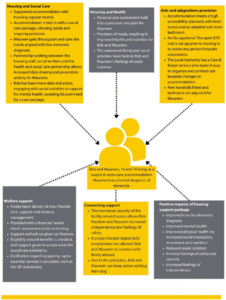
Bob and Maureen, a couple in their 70s, moved into extra care accommodation. Maureen had been diagnosed with dementia three years earlier and Bob had taken on a caring role. The housing support provided to them in their new home enabled the couple to become involved in the social life of the community, build connections with other residents and learn how to digitally connect with their family in Australia.

The social and physical activities made possible through housing support form part of the prevention agenda, enabling people to live better in their own homes for longer.

The HSEU has jointly commissioned further cost and benefit of housing support analysis research, conducted by researchers from CaCHE, the University of Stirling and HACT. The research, which will be launched on Wednesday 1 October, highlights the significant positive impact housing support services have on public finances, as well as preventing crisis and enabling independent living. Sign up to the launch event here.

Housing support services hold vital importance in delivering the objectives of Scottish Government strategies. These policies often emphasise prevention, people-led services and digital transformation, all of which are progressed through housing support models. The HSEU believes existing housing support services can serve as exemplars for the health and social care improvements the Scottish Government seeks, if given its proper recognition.

For more information, read our briefing on three recent Scottish Government strategy and framework documents: the Health and Social Care Service Renewal Framework; Scotland’s Population Health Framework; and Scotland’s Public Service Reform Strategy: Delivering for Scotland.

UK Collaborative Centre for Housing Evidence: The economic and social benefits of housing support

HSEU News: Response to Supported Housing Regulation Consultation

HSEU has submitted a response to the UK government consultation about proposed changes to housing benefit for supported housing.

The Housing Support Enabling Unit has responded to the consultation from the Ministry of Housing, Communities and Local Government and Department of Work and Pensions about future regulation of supported housing.

In addition to the implementation of the Supported Housing (Regulatory Oversight) Act in England, the government is consulting on changes to Housing Benefit Regulations, with the intention to ensure that supported housing is good quality and delivers value for money for the taxpayer. Any changes to housing benefit regulation for supported exempt accommodation will impact providers in Scotland.

After engagement with providers of supported housing in Scotland over the past year, the Unit has heard that with housing-related costs funded by housing benefit, Scottish providers of supported housing deliver high quality accommodation and support that enables people to live as independently as possible in their communities.

The Supported Housing Review 2023 found that to meet existing unmet need in Scotland, an additional 15,300 to 36,400 units of supported housing would be required. Current uncertainty about the housing benefit process and evidence required to assess claims makes it more difficult for providers to develop the new accommodation necessary to meet unmet need. In general, supported housing providers would value a system of funding that was less siloed, to enable longer term strategic planning between local authorities and health and social care partners.

With the government consulting about the definitions for ‘care, support, and supervision’ currently used in the housing benefit guidance for supported exempt accommodation, Scottish supported housing providers would caution against narrow or prescriptive definitions that could limit the flexibility necessary to provide person-centred support. The support provided in supported accommodation is diverse, allowing a person to maintain a tenancy that would otherwise be at risk, which enables them to live safely and participate in their community.

Read the full response here: https://www.ccpscotland.org/wp-content/uploads/2025/05/HSEU-Response-to-Supported-Housing-Regulation-Consultation.pdf

HSEU News: What is Housing Support?

Updated paper outlines the breadth of models of housing support and supported housing in Scotland.

The Housing Support Enabling Unit has launched today an updated paper outlining the diverse models of housing support and supported housing provided across Scotland.

Although housing support is often delivered through the socially rented sector, it should be available to people living across all tenures (social renting; private renting; owner occupied). The paper outlines models and examples of visiting support, Housing First, transitional supported housing, and longer-term supported and sheltered housing.

The beginning of the new financial year is an important time for housing support providers as services are commissioned and contracts are renegotiated. Using examples from different providers, this paper demonstrates that while the features and service model of housing support may vary based on a person’s individual needs and circumstances, all housing support services play a role in supporting people to stay safe and well at home. This includes enabling people to exercise their rights to obtain and keep a home, to live independently, and to participate in the life of their community.

What is Housing Support?: Models of Housing Support and Supported Housing

HSEU News: What impact does the current non-residential charging regime have on the people you support and your services?

COSLA is currently reviewing their guidance for charging for non-residential social care.

Although the Scottish Government previously committed to abolishing charges within the term of this parliament, it is now less clear how this will happen. In the recent Programme for Government, the Scottish Government has committed to ‘continue to work with COSLA to identify options for the removal of non-residential care charges as part of wider work with partners on social care improvement’.

The Scottish Government is interested in hearing more about the impact charging has on supported people and on organisations providing care and support in response to concerns raised recently. Now that personal care is free across all age groups, where charges are applied it is more likely they relate to housing support services.

It is down to each local authority / HSCP to decide their own policies on charging in accordance with guidance produced every year by COSLA.  That guidance is currently being reviewed for 2025/26 and there is an opportunity to put forward changes. An issue that has already been raised with the COSLA charging working group is the scope to dissuade authorities from insisting that their providers collect charges for care and support or at the very least agree rules about recovering the shortfall when supported people are unable to pay the charges. Please do get in touch with the Unit if you have further suggestions about changes to the current COSLA charging guidance.

If you would be interested in submitting a case study example about the currently charging regime or in suggesting changes to the COSLA charging guidance please contact Yvette Burgess at yvette.burgess@ccpscotland.org

HSEU News: Homelessness Statistics show continued need for housing support

Statistics published show that the provision of housing support has not improved for people experiencing homelessness in Scotland.

The homelessness statistics published today, covering the period from April 2023 to March 2024, demonstrate a significant and continued need for housing support services in Scotland.

Overall, the number of homeless households has risen 3% to 33,619 households. The proportion of households reporting at least one support need was 51%, which although is similar to the last few years, is a marked increase from the 33% reported in 2007-2008 when data collection began. The most common support needs identified were mental health problems, and basic housing management/ independent living skills.

All local authorities have a duty to conduct a housing support assessment for households who are assessed as homeless, where it has reason to believe that support would be beneficial. As in 2022-23, the most recent statistics show that in 22% of cases where there was a duty to assess, no assessment took place, and no support was provided. Furthermore, support was not provided for 5% of cases where a support need was identified.

Overall, housing support was provided in 38% of all cases. It is disappointing that the provision of housing support has not improved, given the significant number of people with identified support needs. Housing support has significant economic and social benefits to help people stay safe and well in their homes and maintain a tenancy after being homeless. Today’s homelessness statistics show that action must be taken to ensure that everyone in Scotland who needs it, is supported to live as independently as possible.

Housing support services are essential to enable some people to exercise their rights to obtain and keep a home, to live independently and to participate in the life of their community. While the new prevention duties proposed in the Housing Bill signal an opportunity to improve support for people experiencing homelessness, successful implementation of these duties will require effective partnership working between partners in housing, health and social care.


HSEU News: The Future of Supported Housing as a Response to Homelessness in Scotland

The Supported Housing Task and Finish Group, appointed by Scottish Government and COSLA, publishes its final report today setting out the future role of supported housing in Scotland.

As announced by Homeless Network Scotland, the Supported Housing Task and Finish Group, appointed by Scottish Government and COSLA, publishes its final report today, recommending that national and local emergency plans should prioritise work focused on reducing temporary accommodation and the better targeting of shared and supported forms of housing.

The Task and Finish Group, co-chaired by Homeless Network Scotland chief executive Maggie Brunjes and Scottish Federation of Housing Associations policy lead Eileen McMullan, provides recommendations to the Scottish Government, local authorities and housing providers to create a model that enables social landlords to remodel or reprovision existing models of supported housing.

Yvette Burgess, Unit Director, represented the Housing Support Enabling Unit on the group.

The report recognises that most people can build and live their lives in an ordinary home as part of an ordinary community, but that supported housing should be available for a very small proportion of the population who are unable or don’t want to live in mainstream housing. Importantly, this should be a settled housing option for as long as someone wants it, and therefore breaking the stigma of ‘homeless’ supported housing altogether.

The review was informed by evidence from expert contributors on housing and support themes, a survey of 19 local authorities providing supported accommodation across Scotland, case studies of existing good practice, and lived experience expertise.

Key recommendations from the evidence-led review include:

  • An ideal model of supported housing offering a self-contained home in a smaller-scale setting, with its own bathroom and cooking facilities, easy access to great support, some common space, and consistent quality standards.
  • Maximising security of tenure for tenants plus fair funding arrangements to make sure no one is stuck in a life-limiting ‘benefit trap’ created by high rents.
  • Moving to a joint funding and commissioning model between health and social care partnerships and local authorities, to break the ‘care group’ stigma attached to supported housing’s legacy as shared ‘homeless’ accommodation.

The report also recommends that housing and support providers work with the local authority and HSCP on an integrated plan for supported housing in each area to improve provision.

You can read the full report and a summary report on the Homeless Network Scotland website.